
Blog
Perimenopause Exposes Old Strategies: A guide for women experiencing the shift — and the partners walking beside them
Perimenopause Doesn’t Create Emotional Problems
It Exposes the Limits of Old Coping Strategies
A guide for women experiencing the shift — and the partners walking beside them
Perimenopause often arrives quietly. Rarely is there a single moment when someone says, ‘This is happening now.’ Instead, it starts as a feeling — something slightly off. The nervous system doesn’t settle as easily. Emotions feel louder. Fatigue lingers. What once worked… doesn’t anymore.
For many women, this is deeply unsettling. For their partners, it can be confusing and even frightening to witness.
I created this blog to offer context, clarity, and relief — not just for women navigating perimenopause, but for the partners learning how to stand alongside them without losing themselves or the relationship in the process.
Because one thing matters above all else:
Perimenopause doesn’t create emotional problems.
It exposes the limits of old coping strategies.
What Perimenopause Is — and Why It Happens
Perimenopause is the biological transition leading up to menopause, when the body gradually shifts out of its reproductive years. It often begins earlier than most people expect — sometimes in the late 30s, more commonly in the 40s — and can last many years. Menopause itself is defined as twelve consecutive months without a menstrual cycle. Perimenopause is everything that happens before that marker.
What makes perimenopause difficult is not just that hormones change — it’s how they change.
Rather than declining in a smooth, predictable way, estrogen and progesterone fluctuate. They spike, dip, surge, and crash. The communication loop between the brain and ovaries becomes less synchronized. Ovulation becomes inconsistent. Progesterone — a hormone that has a calming, stabilizing effect on the nervous system — is often produced less reliably.
This creates an internal environment that is constantly shifting.
The nervous system depends on consistency to regulate stress, emotion, sleep, and recovery. When internal signals become unpredictable, the nervous system has to work harder just to maintain equilibrium.
That extra effort shows up as symptoms.
Not because something is wrong — but because something is changing.
Partner Lens
Many partners assume menopause is a single event — the end of periods, maybe hot flashes, then it’s “over.” Understanding that perimenopause is a long neurological transition helps explain why this phase can feel harder than expected, and why patience and education matter more than quick fixes.
Perimenopause Is a Nervous System Transition
Estrogen and progesterone are not just reproductive hormones. They are neuroactive — meaning they directly affect the brain and nervous system.
Estrogen supports serotonin, which helps regulate mood and emotional stability. It influences dopamine, which affects motivation, focus, and reward. Progesterone supports GABA, a neurotransmitter that acts like a braking system for the nervous system, helping the body feel calm and settled.
When these hormones fluctuate, the nervous system loses some of its buffering capacity.
This can show up as:
-
heightened emotional reactivity
-
anxiety or panic symptoms
-
irritability or rage
-
emotional sensitivity
-
sleep disruption
-
difficulty concentrating or feeling “foggy”
Many women experiencing this have never struggled with anxiety or emotional instability before. That’s part of what makes it so alarming.
But this isn’t psychological fragility.
It’s a nervous system responding to altered internal conditions.
Partner Lens
From the outside, these moments can look like overreaction or unpredictability. But when partners understand that hormonal shifts heighten the brain’s threat detection and emotional intensity, it becomes easier not to take it personally—which is key, because personalizing it only escalates things. It’s about her, not you.
Why High-Functioning Women Feel This So Intensely
Many women entering perimenopause are exceptionally good at emotional regulation — or more accurately, emotional suppression.
They are often:
-
capable
-
responsible
-
dependable
-
emotionally contained
-
used to being the steady one
These traits are usually praised. But they’re also adaptive strategies, not personality traits.
At some point earlier in life, the nervous system learned:
“If I stay composed, useful, and emotionally contained, I stay safe and valued.”
That strategy often works very well — especially when supported by hormonal stability.
But suppression is not passive. It takes energy. It requires constant nervous system vigilance, muscular tension, and elevated stress hormones.
Perimenopause reduces the body’s ability to sustain that effort.
Sleep is disrupted. Recovery takes longer. Cortisol lingers. Emotional processing slows.
So the body begins to say:
“I can’t hold this the way I used to.”
Not as a failure — as information.
Partner Lens
If your partner has always been “the strong one,” it can be disorienting to see her struggle now. This isn’t a loss of character — it’s the nervous system no longer masking strain.
When Old Coping Strategies Reach Their Limit
When suppression stops working, emotions don’t disappear — they change form.
Instead of sadness, there may be irritability.
Instead of fear, anxiety.
Instead of grief, numbness or rage.
Instead of words, physical symptoms.
Many women say:
“I don’t even know what I’m feeling — I just know something is wrong.”
This isn’t emotional immaturity or regression. It’s a nervous system that has relied on containment for so long it hasn’t needed to translate sensation into language — until now.
Perimenopause doesn’t create emotional problems.
It reveals where emotions were managed instead of metabolized.
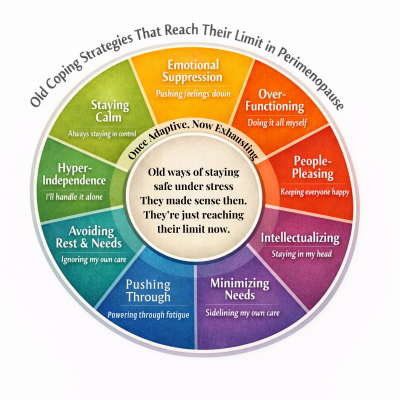
Common Coping Strategies That Get Challenged
1. Emotional Suppression
-
What it looked like: “I’ll deal with this later.”
-
How it helped: Kept peace, prevented overwhelm, allowed productivity.
-
How it shows up now: Emotions leak as irritability, anxiety, tears, or rage.
2. Over-Functioning / Doing It All
-
What it looked like: “If I stay useful, everything stays okay.”
-
How it helped: Created stability and approval.
-
How it shows up now: Exhaustion, resentment, burnout.
3. People-Pleasing / Harmony Keeping
-
What it looked like: “I’ll adapt so no one’s upset.”
-
How it helped: Maintained connection and reduced conflict.
-
How it shows up now: Sudden boundaries, lower tolerance for emotional labor.
4. Intellectualizing Emotions
-
What it looked like: “I understand why I feel this way, so I should be fine.”
-
How it helped: Created distance, gave control.
-
How it shows up now: Insight without relief.
5. Pushing Through / Endurance Mode
-
What it looked like: “I can handle it. I always have.”
-
How it helped: Built resilience.
-
How it shows up now: Reduced tolerance, frequent overwhelm.
6. Avoiding Needs or Rest
-
What it looked like: “I don’t need much. I’ll rest later.”
-
How it helped: Maintained independence.
-
How it shows up now: Sleep disruption, emotional depletion.
7. Hyper-Independence
-
What it looked like: “I’ll figure it out myself.”
-
How it helped: Protected against disappointment.
-
How it shows up now: Loneliness, frustration, difficulty receiving help.
8. Staying Calm at All Costs
-
What it looked like: “Strong women don’t fall apart.”
-
How it helped: Maintained control.
-
How it shows up now: Sudden emotional release.
Partner Lens
Trying to “logic” emotions away or offer quick fixes often backfires. What’s most helpful is staying calm, grounded, and present, even when emotions feel intense. Your steady presence helps regulate her nervous system, showing that it’s safe to feel without judgment. Listening, validating, and allowing space for expression — without trying to solve, explain, or minimize — is far more powerful than advice.
Think of it like this: your composure and empathy are co-regulation tools. By staying present and non-reactive, you help her nervous system settle faster, which in turn helps the emotional waves pass more smoothly for both of you.
Why Talking Isn’t Always Enough
Many women are surprised to discover that talking through their feelings doesn’t resolve them — and in some cases, it can even make things feel worse. This can feel confusing or frustrating, especially if you’ve relied on logic, reflection, or discussion to manage stress your whole life.
The reason is that perimenopause often requires bottom-up regulation, not top-down processing. In other words, you can’t think your way calm. You can’t “logic” your nervous system into stability. Have you ever heard someone say, “Calm down!” — and instantly felt calm? Of course not. That’s because calmness isn’t a thought, it’s a physiological state. The body has to lead, and the mind follows.
Example:
- Top-down: “I need to calm down. Stop feeling anxious!” → often ineffective, can feel frustrating
-
Bottom-up: Slow, intentional breathing; noticing physical sensations; gentle movement → nervous system calms, anxiety reduces, thinking becomes clear
Bottom-up processing is essentially letting the body lead the way back to regulation. It’s not avoidance — it’s biology working as it was designed.
During perimenopause, hormonal fluctuations make the nervous system more sensitive, more reactive, and slower to self-regulate. The body can feel on edge, the heart racing, thoughts spinning, emotions heightened — even when there is no external threat. Talking about feelings can sometimes amplify this because the system isn’t ready to process insight yet; it’s still in survival mode.
To move through emotional intensity safely, the nervous system needs three things in order:
-
Safety — the system needs to know it is not under immediate threat before it can relax or process emotion.
-
Regulation — the nervous system needs to downshift from fight/flight/freeze to a state where energy can move through the body without triggering overwhelm.
-
Sensation & Rhythm — before words or analysis, the body needs a chance to discharge tension through breath, movement, or other somatic cues.
This is why body-based practices are so essential during perimenopause. They help women meet their physiology where it is, rather than trying to impose control from the thinking mind. One of the most effective tools is Introspective Breathwork®. Through intentional breathing patterns, the nervous system is guided into a state of parasympathetic activation — the “rest and digest” mode — which allows emotions to move safely, rather than get stuck in suppression or overwhelm.
Ultimately, talking is a wonderful tool — but it works best after the body has had a chance to settle. Without bottom-up regulation, words may feel like pushing against a current rather than moving with the flow. Breath, rhythm, and sensation come first; insight follows naturally.
Before words, it needs breath, rhythm, and sensation.
This is where body-based practices become essential.
A Gentle Warning: It May Feel Harder Before It Feels Better
As you begin to work with your nervous system — through breathwork, movement, or other body-based practices — it’s normal for emotions, tension, or even physical sensations to intensify briefly.
Think of it like shaking out a garden hose that’s been coiled for years: some knots and tension may surface before the hose lies smooth again.
This isn’t a sign that you’re doing it wrong. It’s your nervous system releasing old patterns and recalibrating. The intensity usually passes faster each time, and over time you’ll notice:
-
Greater emotional clarity
-
Less reactive responses
-
Increased resilience and regulation
-
A sense of safety in your body
Partners, it’s worth noting that you may witness these temporary spikes too. Staying grounded, present, and non-reactive supports both your loved one and yourself during this recalibration.
This Is Not a Breakdown — It’s a Transition
Perimenopause asks a profound question:
What if strength didn’t mean carrying everything alone anymore?
For women, it invites a redefinition of resilience.
For partners, it invites presence over solutions.
For relationships, it invites honesty, pacing, and compassion.
No one is broken here.
A system is evolving.
And when that evolution is met with understanding — rather than judgment — this phase can become not just survivable, but meaningful.
Why Introspective Breathwork® Is So Supportive During Perimenopause
Introspective Breathwork® works directly with the nervous system, rather than asking the mind to lead the process. This isn’t just helpful for women. Partners can also benefit from participating. Learning to regulate their own nervous systems while witnessing these processes helps them stay grounded, non-reactive, and supportive, which in turn stabilizes the relational environment. Calm partners act as co-regulators — their presence helps the woman in perimenopause feel safer, making emotional processing more effective and reducing relational tension.
Through guided breathing, the body is invited out of chronic sympathetic activation (fight-or-flight) and into a state where emotions can move without overwhelming the system.
For women in perimenopause, this is especially powerful because it:
-
supports emotional release without requiring storytelling
-
helps discharge stored stress and tension
-
restores parasympathetic nervous system activity
-
improves interoceptive awareness (the ability to feel and interpret internal cues)
-
builds capacity rather than forcing catharsis
Instead of pushing emotions down or opening floodgates, breathwork creates a regulated middle ground — a place where emotions can move safely.
This matters deeply during hormonal fluctuation.
Partner Lens
Partners often feel helpless watching emotional waves rise. Knowing your partner has a practice that helps her regulate from the body up can reduce fear and pressure to fix or manage emotions yourself.
How Introspective Breathwork® Benefits Partners Too
Perimenopause doesn’t happen in isolation — it affects relationships as much as it affects individuals. Partners often find themselves carrying a heavy mix of emotions: uncertainty, tension, heightened vigilance, worry about saying the wrong thing, or even grief for how things used to feel. These reactions are natural because emotional intensity, unpredictability, and physiological changes in their partner can ripple through the relational system.
Introspective Breathwork® offers a way for partners to support themselves and the relationship simultaneously. By engaging in guided, body-centered breathing, partners can:
-
Reduce their own nervous system activation: Breathwork activates the parasympathetic nervous system — the “rest and digest” state — lowering tension and stress hormones.
-
Increase emotional tolerance without shutdown: Partners learn to stay present with strong emotions without freezing, withdrawing, or overreacting.
-
Improve co-regulation: When one person is dysregulated, a calm partner can act as a stabilizing force. Introspective Breathwork® Therapy strengthens this skill, helping both people move toward equilibrium together.
-
Stay present without absorbing stress: Partners can witness intense emotional experiences without taking them on personally, maintaining empathy without burnout.
When both nervous systems are supported — the woman navigating perimenopause and her partner — the relationship naturally stabilizes. Introspective Breathwork® isn’t about “fixing” anyone or changing someone’s personality. It’s about creating a shared environment of regulation, where both partners feel safer, calmer, and more connected.
In other words, this work teaches partners that their own calm is one of the greatest gifts they can offer, and that regulation can be learned together, one breath at a time.
If This Resonated, You’re Not Meant to Navigate It Alone
If you recognized yourself in these words — or recognized someone you love — know that this transition doesn’t have to be carried silently or explained away.
Support during perimenopause doesn’t have to mean digging into the past, forcing emotional clarity, or “figuring it all out.” Often, what helps most is giving the nervous system a safe place to settle, reset, and learn a new way of being with change.
Introspective Breathwork® is one way I support women moving through perimenopause — and the partners walking alongside them — by working directly with the body and nervous system. These sessions are designed to be:
-
trauma-aware and nervous-system informed
-
gentle, grounded, and paced
-
supportive without requiring sharing or emotional performance
-
accessible whether you’re coming alone or together
For many women, breathwork becomes a place where emotions can move without overwhelm.
For partners, it often becomes a way to feel steadier, more present, and less helpless in the face of change.
If you’re curious, you’re welcome to explore this work at your own pace.
No fixing. No forcing. Just support.
You can learn more about upcoming sessions or work with me directly at
www.IntrospectiveWithAmy.com
Wherever you are in this transition — questioning, learning, or simply trying to understand — you’re welcome here.